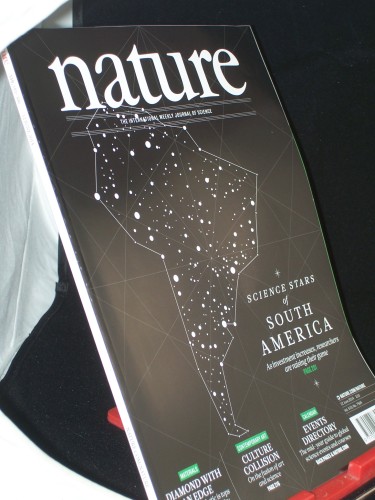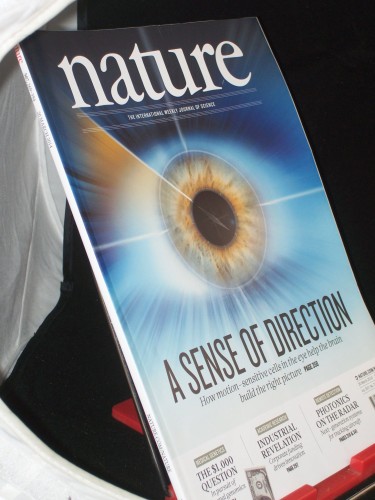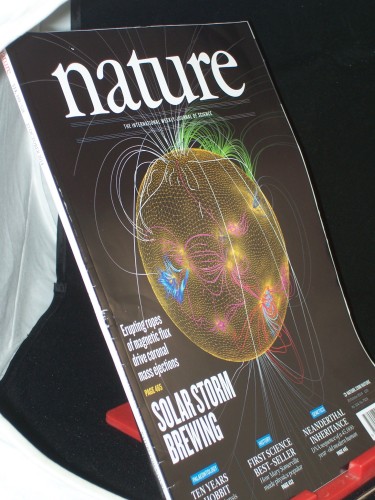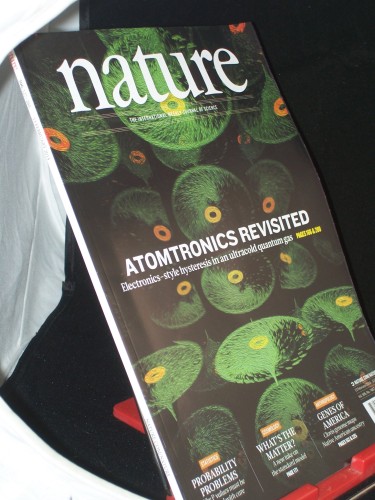
Working together: A call for inclusive conservation
Heather Tallis, Jane Lubchenco and 238 co-signatories petition for an end to the infighting that is stalling progress in protecting the planet.
Conservation: A to-do list for the world's parks
Experts share their priorities for what must be done to make protected areas more effective at conserving global biodiversity.
Economics: Account for depreciation of natural capital
Economic indicators that omit the depletion and degradation of natural resources and ecosystems are misleading, warns Edward B. Barbier.
History of science: Chemists behaving badly
Theodore Gray revels in the ego-ridden story of the elements that never were.
Review of The Lost Elements: The Periodic Table's Shadow Side
Marco Fontani, Mariagrazia Costa & Mary Virginia Orna
Books in brief
Barbara Kiser reviews five of the week's best science picks.
Chemistry: A life in science and literature
Alison Abbott reviews the latest autobiography of Carl Djerassi, father of the Pill.
Review of In Retrospect: From the Pill to the Pen
Carl Djerassi
Insight: Sustainable ecosystems and society
Sustainable ecosystems and society
Patrick Goymer
Implications of agricultural transitions and urbanization for ecosystem services
Graeme S. Cumming,
Andreas Buerkert,
Ellen M. Hoffmann,
Eva Schlecht,
Stephan von Cramon-Taubadel
+ et al.
Learning to coexist with wildfire
Max A. Moritz,
Enric Batllori,
Ross A. Bradstock,
A. Malcolm Gill,
John Handmer
+ et al.
The performance and potential of protected areas
James E. M. Watson,
Nigel Dudley,
Daniel B. Segan &
Marc Hockings
Accelerator physics: Surf's up at SLAC
Mike Downer &
Rafal Zgadzaj
See also
Letter by Litos et al.
Developmental biology: Cells unite by trapping a signal
James Sharpe
See also
Letter by Durdu et al.
Astrophysics: Monster star found hiding in plain sight
Donald F. Figer
50 & 100 Years Ago
Ecology: Diversity breeds complementarity
David Tilman &
Emilie C. Snell-Rood
See also
Letter by Zuppinger-Dingley et al.
Organic chemistry: Shape control in reactions with light
Kazimer L. Skubi &
Tehshik P. Yoon
See also
Letter by Huo et al.
Cancer: Metastasis risk after anti-macrophage therapy
Ioanna Keklikoglou &
Michele De Palma
See also
Letter by Bonapace et al.
Articles
Top
Life cycles, fitness decoupling and the evolution of multicellularity
Katrin Hammerschmidt,
Caroline J. Rose,
Benjamin Kerr &
Paul B. Rainey
Simple cooperating groups of bacteria reproduced either by embracing or purging cheating types; those that embraced cheats adopted a life cycle of alternating phenotypic states, underpinned by a developmental switch that allowed the fitness of collectives to decouple from the fitness of constituent cells.
Architecture of mammalian respiratory complex I
Kutti R. Vinothkumar,
Jiapeng Zhu &
Judy Hirst
Complex I is the first enzyme of the mitochondrial electron transport chain and it is essential for oxidative phosphorylation in mammalian mitochondria; here the electron cryo-microscopy structure of complex I from bovine heart mitochondria is reported, advancing knowledge of its structure in mammals.
Letters
Top
Turbulent heating in galaxy clusters brightest in X-rays
I. Zhuravleva,
E. Churazov,
A. A. Schekochihin,
S. W. Allen,
P. Arévalo
+ et al.
Analysis of X-ray data of galaxy clusters shows that turbulent heating of the intracluster medium is sufficient to counteract the radiative energy losses from the medium.
Suppression of cooling by strong magnetic fields in white dwarf stars
G. Valyavin,
D. Shulyak,
G. A. Wade,
K. Antonyuk,
S. V. Zharikov
+ et al.
Cool white dwarf stars often have mysteriously strong magnetic fields (because their coolness suggests that they are old, and magnetic fields should decline in strength with age) and unexplained brightness variations; here the magnetic field is shown to suppress atmospheric convection, inhibiting cooling evolution and causing dark spots.
High-efficiency acceleration of an electron beam in a plasma wakefield accelerator
M. Litos,
E. Adli,
W. An,
C. I. Clarke,
C. E. Clayton
+ et al.
To develop plasma wakefield acceleration into a compact and affordable replacement for conventional accelerators, beams of charged particles must be accelerated at high efficiency in a high electric field; here this is demonstrated for a bunch of charged electrons ‘surfing’ on a previously excited plasma wave.
See also
News & Views by Downer & Zgadzaj
Solution-processed, high-performance light-emitting diodes based on quantum dots
Xingliang Dai,
Zhenxing Zhang,
Yizheng Jin,
Yuan Niu,
Hujia Cao
+ et al.
The insertion of an insulating layer into a multilayer light-emitting diode (LED) based on quantum dots and produced by depositing the layers from solution increases the performance of the LEDs to levels comparable to those of state-of-the-art organic LEDs produced by vacuum deposition, while retaining the advantages of solution processing.
Asymmetric photoredox transition-metal catalysis activated by visible light
Haohua Huo,
Xiaodong Shen,
Chuanyong Wang,
Lilu Zhang,
Philipp Röse
+ et al.
A chiral iridium complex serves as a sensitizer for photoredox catalysis and at the same time provides very effective asymmetric induction for the enantioselective alkylation of 2-acyl imidazoles; the metal centre simultaneously serves as the exclusive source of chirality, the catalytically active Lewis acid centre, and the photoredox centre.
See also
News & Views by Skubi & Yoon
Recent Northern Hemisphere stratospheric HCl increase due to atmospheric circulation changes
E. Mahieu,
M. P. Chipperfield,
J. Notholt,
T. Reddmann,
J. Anderson
+ et al.
Policies have been in place since 1987 to reduce the release of chlorine atoms in the stratosphere, where they deplete ozone; here observations show that since 2007 hydrogen chloride has been increasing in the lower stratosphere of the Northern Hemisphere, an increase that is attributed to a slowdown in atmospheric circulation.
Selection for niche differentiation in plant communities increases biodiversity effects
Debra Zuppinger-Dingley,
Bernhard Schmid,
Jana S. Petermann,
Varuna Yadav,
Gerlinde B. De Deyn
+ et al.
Here, new ecological communities are established using plants from mixed-species communities or monocultures; ecosystem functioning and morphological trait diversity are shown to be greater in plants from mixed-species communities, suggesting that biodiversity effects in natural communities strengthen over time.
See also
News & Views by Tilman & Snell-Rood
Nodal signalling determines biradial asymmetry in Hydra
Hiroshi Watanabe,
Heiko A. Schmidt,
Anne Kuhn,
Stefanie K. Höger,
Yigit Kocagöz
+ et al.
A Nodal-related gene is uncovered in Hydra and is involved in setting up the body axis, and a β-Catenin–Nodal–Pitx signalling cassette is shown to have existed before the divergence of cnidarians, including Hydra, and bilaterians.
Sensory-evoked LTP driven by dendritic plateau potentials in vivo
Frédéric Gambino,
Stéphane Pagès,
Vassilis Kehayas,
Daniela Baptista,
Roberta Tatti
+ et al.
Whole-cell recordings in mouse somatosensory cortex in vivo show that rhythmic sensory-whisker stimulation induces long-term synaptic potentiation (LTP) in layer 2/3 (L2/3) pyramidal cells, in the absence of somatic spikes, through long-lasting NMDAR-mediated depolarizations that are generated by synaptic networks originating from the posteromedial complex of the thalamus.
Luminal signalling links cell communication to tissue architecture during organogenesis
Sevi Durdu,
Murat Iskar,
Celine Revenu,
Nicole Schieber,
Andreas Kunze
+ et al.
Groups of cells within a migrating collective assemble shared luminal cavities that trap and concentrate the signalling molecule fibroblast growth factor, providing a self-organising mechanism to focus and coordinate cell communication within tissues.
See also
News & Views by Sharpe
PLETHORA gradient formation mechanism separates auxin responses
Ari Pekka Mähönen,
Kirsten ten Tusscher,
Riccardo Siligato,
Ondřej Smetana,
Sara Díaz-Triviño
+ et al.
Through a combination of experimental and computational approaches, the interplay between the plant hormone auxin and the auxin-induced PLETHORA transcription factors is shown to control zonation and gravity-prompted growth movements in plants.
Cessation of CCL2 inhibition accelerates breast cancer metastasis by promoting angiogenesis
Laura Bonapace,
Marie-May Coissieux,
Jeffrey Wyckoff,
Kirsten D. Mertz,
Zsuzsanna Varga
+ et al.
In mouse models of breast cancer, anti-CCL2 therapy—thought to be potentially useful in treating cancer—is shown to accelerate the growth of lung metastases on discontinuation due to a surge of recruitment of bone marrow monocytes and increased interleukin-6-dependent vascularization of the lung metastatic environment.
See also
News & Views by Keklikoglou & De Palma
Tumour-infiltrating Gr-1+ myeloid cells antagonize senescence in cancer
Diletta Di Mitri,
Alberto Toso,
Jing Jing Chen,
Manuela Sarti,
Sandra Pinton
+ et al.
Senescence in cancer can be antagonized by a subset of immune cells acting in a non-cell-autonomous manner.
Broad and potent HIV-1 neutralization by a human antibody that binds the gp41–gp120 interface
Jinghe Huang,
Byong H. Kang,
Marie Pancera,
Jeong Hyun Lee,
Tommy Tong
+ et al.
Molecular and structural characterization is reported for a new broad and potent monoclonal antibody against HIV that binds to an epitope bridging the gp41 and gp120 subunits — the antibody affects a step in virus entry after binding to CD4 and before engagement of CCR5.
Pseudouridine profiling reveals regulated mRNA pseudouridylation in yeast and human cells
Thomas M. Carlile,
Maria F. Rojas-Duran,
Boris Zinshteyn,
Hakyung Shin,
Kristen M. Bartoli
+ et al.
The modification of uridine to pseudouridine is widespread in transfer and ribosomal RNAs but not observed so far in a coding RNA; here a new technique is used to detect this modification on a genome-wide scale, leading to the identification of pseudouridylation in messenger RNAs as well as almost 100 new sites in non-coding RNAs.
Crystal structure of the RNA-guided immune surveillance Cascade complex in Escherichia coli
Hongtu Zhao,
Gang Sheng,
Jiuyu Wang,
Min Wang,
Gabor Bunkoczi
+ et al.
The CRISPR/Cas system is an RNA-guided bacterial protection system against foreign nucleic acids of bacterial and archaeal origin; here a high-resolution crystal structure of the CRIPSR RNA–Cas complex shows that the CRIPSR RNA plays an essential role not only in target recognition but also in complex assembly.
gepflegtes Exemplar, nur kleine Lesespuren
- Verlag:
- NPG Nature publishing group
- Englische Ausgabe
- Artikelnummer:
- B00042578
- Gewicht:
- 400 gr
- Lagerplatz:
- Z7_4_18