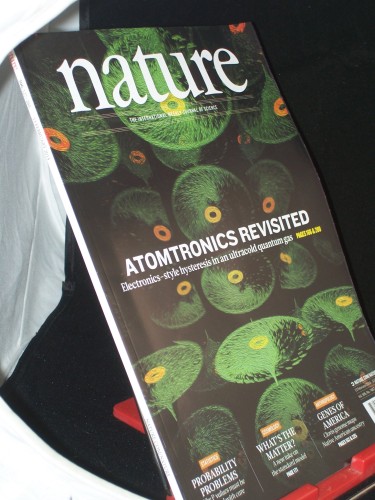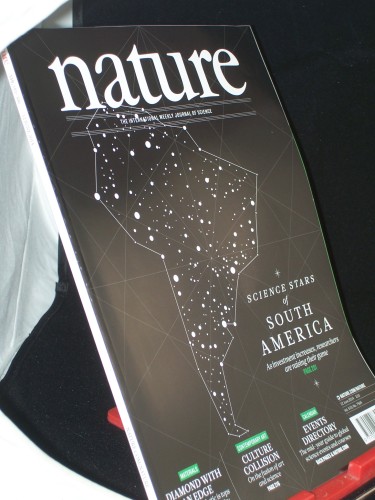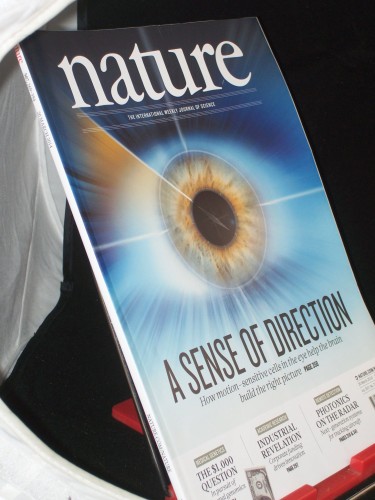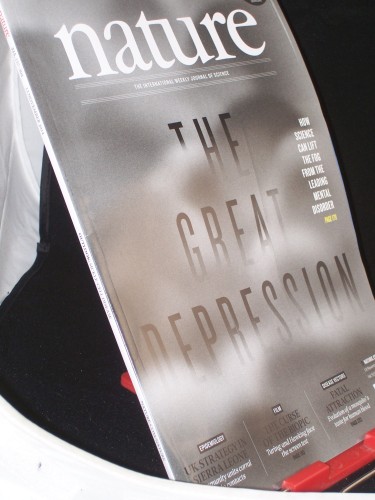
Synthetic biology: How best to build a cell
Experts weigh in on the biggest obstacles in synthetic biology — from names to knowledge gaps — and what it will take to overcome them.
Society: Realizing China's urban dream
Local implementation and public scrutiny will make or break the government's urbanization strategy, say Xuemei Bai, Peijun Shi and Yansui Liu.
Books and Arts
Top
Developmental biology: Life in flux
Renee Reijo Pera enjoys a treatise tracking the rise of embryology, from Aristotle to cloning and beyond.
Review of Embryos Under the Microscope: The Diverging Meanings of Life
Jane Maienschein
Q&A: Canopy composer
Sound artist Daniel Jones creates self-generating artworks based on human and natural patterns and processes. As he prepares to travel through four UK forests with the installation Living Symphonies, a collaboration with artist James Bulley, he talks about music that emerges from ecosystem dynamics, and works inspired by bacterial genetics and social networks.
Review of Living Symphonies
Daniel Jones & James Bulley
Forum
Synthetic biology: Engineering explored
Pamela A. Silver,
Jeffrey C. Way,
Frances H. Arnold &
Joseph T. Meyerowitz
Climate science: The origin of regional Arctic warming
Jürgen Bader
See also
Letter by Ding et al.
Synthetic biology: Construction of a yeast chromosome
Daniel G. Gibson &
J. Craig Venter
Cosmology: A virtual Universe
Michael Boylan-Kolchin
See also
Article by Vogelsberger et al.
Biodiversity: Supply and demand
Arne O. Mooers
See also
Letter by Price et al.
Ecology: Diversity in the afterlife
Jennie R. McLaren
See also
Letter by Handa et al.
Structural biology: Action at a distance in a light receptor
Anna W. Baker &
Katrina T. Forest
See also
Letter by Takala et al.
Articles
Top
Properties of galaxies reproduced by a hydrodynamic simulation
M. Vogelsberger,
S. Genel,
V. Springel,
P. Torrey,
D. Sijacki
+ et al.
A simulation that starts 12 million years after the Big Bang and traces 13 billion years of cosmic evolution yields a reasonable population of elliptical and spiral galaxies, reproduces the observed distribution of galaxies in clusters and the characteristics of hydrogen on large scales, and at the same time matches the ‘metal’ and hydrogen content of galaxies on small scales.
See also
News & Views by Boylan-Kolchin
FXR is a molecular target for the effects of vertical sleeve gastrectomy
Karen K. Ryan,
Valentina Tremaroli,
Christoffer Clemmensen,
Petia Kovatcheva-Datchary,
Andriy Myronovych
+ et al.
Bariatric surgical procedures, such as vertical sleeve gastrectomy (VSG), are the most effective therapy for the treatment of obesity; now bile acids, and the presence of the nuclear bile acid receptor FXR, are shown to underpin the mechanism of VSG action, and the ability of VSG to reduce body weight and improve glucose tolerance is substantially reduced if FXR is absent.
Astrocyte-encoded positional cues maintain sensorimotor circuit integrity
Anna V. Molofsky,
Kevin W. Kelley,
Hui-Hsin Tsai,
Stephanie A. Redmond,
Sandra M. Chang
+ et al.
Populations of astrocytes in the spinal cord are shown to express region-specific genes, with ventral astrocyte-encoded Sema3a necessary for proper motor neuron circuit organization and typical sensory afferent projection patterns; these findings suggest that astrocytes provide a positional cue for maintaining proper circuit formation and refinement.
Synapse elimination and learning rules co-regulated by MHC class I H2-Db
Hanmi Lee,
Barbara K. Brott,
Lowry A. Kirkby,
Jaimie D. Adelson,
Sarah Cheng
+ et al.
This study reveals a role for the MHC class I molecule H2-Db in retinogeniculate synapse elimination; expression of this immune system molecule in neurons lacking it is sufficient to rescue proper synapse pruning, as well as the segregation of eye-specific circuits in mice.
Letters
Top
Circular polarization in the optical afterglow of GRB 121024A
K. Wiersema,
S. Covino,
K. Toma,
A. J. van der Horst,
K. Varela
+ et al.
Circularly polarized light is unexpectedly detected in the afterglow of γ-ray burst GRB 121024A measured 0.15 days after the burst, and is shown to be intrinsic to the afterglow and unlikely to be produced by dust scattering or plasma propagation effects.
Classical shear cracks drive the onset of dry frictional motion
Ilya Svetlizky &
Jay Fineberg
The transition between ‘static’ and ‘dynamic’ friction in a model system is found to be quantitatively captured by the same theoretical framework as is used to describe brittle fracture, but deviations from this correspondence are observed as the rupture velocity approaches the speed at which sound waves propagate along the interface.
Tropical forcing of the recent rapid Arctic warming in northeastern Canada and Greenland
Qinghua Ding,
John M. Wallace,
David S. Battisti,
Eric J. Steig,
Ailie J. E. Gallant
+ et al.
Human-induced climate change is usually assumed to be responsible for the dramatic thawing of glaciers since the mid 1990s in Greenland and northeastern Canada; approximately half of the observed warming in this region during this period is now found to be attributable to atmospheric circulation changes that may be of natural origin.
See also
News & Views by Bader
Predicting biodiversity change and averting collapse in agricultural landscapes
Chase D. Mendenhall,
Daniel S. Karp,
Christoph F. J. Meyer,
Elizabeth A. Hadly &
Gretchen C. Daily
A new, holistic view of countryside biogeography is emerging for the world’s human-modified habitats and the biodiversity they support.
Consequences of biodiversity loss for litter decomposition across biomes
I. Tanya Handa,
Rien Aerts,
Frank Berendse,
Matty P. Berg,
Andreas Bruder
+ et al.
Field experiments across aquatic and terrestrial ecosystems show that biodiversity positively affects carbon and nitrogen cycling in leaf litter decomposition, indicating that reduced decomposition caused by biodiversity loss would modify the global carbon cycle and limit the nitrogen supply to the organisms at the base of the food chain.
See also
News & Views by McLaren
Niche filling slows the diversification of Himalayan songbirds
Trevor D. Price,
Daniel M. Hooper,
Caitlyn D. Buchanan,
Ulf S. Johansson,
D. Thomas Tietze
+ et al.
In Himalayan songbirds, the speciation rate is ultimately set by ecological competition, rather than by the rate of acquisition of reproductive isolation.
See also
News & Views by Mooers
Sensory stimulation shifts visual cortex from synchronous to asynchronous states
Andrew Y. Y. Tan,
Yuzhi Chen,
Benjamin Scholl,
Eyal Seidemann &
Nicholas J. Priebe
Intracellular recordings distinguish between mechanisms that can account for variability in primary visual cortex of alert primates, consistent with a scheme in which spiking is driven by infrequent synchronous events during fixation, with sensory stimulation shifting the cortex to an asynchronous state.
Listeria monocytogenes exploits efferocytosis to promote cell-to-cell spread
Mark A. Czuczman,
Ramzi Fattouh,
Jorik M. van Rijn,
Veronica Canadien,
Suzanne Osborne
+ et al.
The intracellular bacterial pathogen Listeria monocytogenes is shown to exploit efferocytosis—the process by which dead or dying cells are removed by phagocytosis—to promote cell-to-cell spread during infection.
NRROS negatively regulates reactive oxygen species during host defence and autoimmunity
Rajkumar Noubade,
Kit Wong,
Naruhisa Ota,
Sascha Rutz,
Celine Eidenschenk
+ et al.
The leucine-rich repeat protein NRROS which resides in the endoplasmic reticulum regulates phagocytic NADPH oxidase, minimizing collateral tissue damage caused by reactive oxygen species during inflammatory processes.
Endosomes are specialized platforms for bacterial sensing and NOD2 signalling
Norihiro Nakamura,
Jennie R. Lill,
Qui Phung,
Zhaoshi Jiang,
Corey Bakalarski
+ et al.
The endo-lysosomal transporters SLC15A3 and SLC15A4 provide a portal of entry for extracellular bacterial products that activate the cytoplasmic sensor NOD2; these results establish the importance of endosomes as signalling platforms specialized for triggering innate immune responses.
Signal amplification and transduction in phytochrome photosensors
Heikki Takala,
Alexander Björling,
Oskar Berntsson,
Heli Lehtivuori,
Stephan Niebling
+ et al.
The solution and crystal structures of a bacterial phytochrome photosensory core in both its resting and activated states are determined; switching between closed (resting) and open (activated) forms is found to be mediated by a conserved ‘tongue’, and the structures indicate that smaller changes in the vicinity of the chromophore are amplified in scale as they are transmitted through the tongue and beyond.
See also
News & Views by Baker & Forest
gepflegtes Exemplar, nur kleine Lesespuren
- Verlag:
- NPG Nature publishing group
- Englische Ausgabe
- Artikelnummer:
- B00042568
- Gewicht:
- 400 gr
- Lagerplatz:
- Z7_4_17