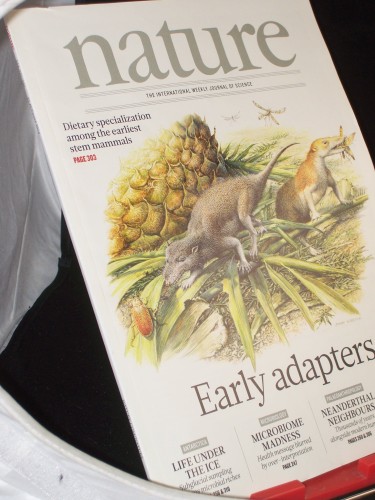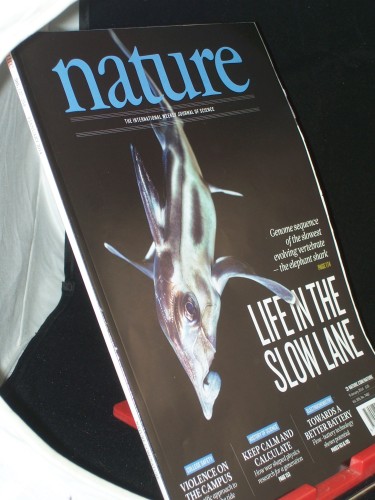
Climate policy: Rethink IPCC reports
Voluntary work alone cannot sustain the assessments carried out by the Intergovernmental Panel on Climate Change. Thomas F. Stocker and Gian-Kasper Plattner call for institutional support and a longer report cycle.
Economics: Manufacture renewables to build energy security
Countries should follow China's lead and boost markets for water, wind and solar power technologies to drive down costs, say John A. Mathews and Hao Tan.
Science fiction: Verne and beyond
Danièle Chatelain and George Slusser explore how French science fiction grapples with Cartesian duality.
Q&A: The sci-fi optimist
Best-selling science-fiction writer Neal Stephenson's works cover everything from cryptography to Sumerian mythology. Ahead of next year's novel Seveneves, he talks about his influences, the stagnation in material technologies, and Hieroglyph, the forthcoming science-fiction anthology that he kick-started to stimulate the next generation of engineers.
Books in brief
Barbara Kiser reviews five of the week's best science picks.
Lung cancer
Herb Brody
Epidemiology: The dominant malignancy
Eric Bender
Diagnosis: Early warning system
Katherine Bourzac
Perspective: The screening imperative
John K. Field
Personalized medicine: Special treatment
Michael Eisenstein
Immunotherapy: Chemical tricks
Bianca Nogrady
Aetiology: Crucial clues
Sarah Deweerdt
Environment: Breathing trouble
Traci Watson
Public health: A burning issue
Nidhi Subbaraman
Genomics: Something to swing about
Michael J. O'Neill &
Rachel J. O'Neill
See also
Article by Carbone et al.
Microbiology: Bacteria get vaccinated
Rodolphe Barrangou &
Todd R. Klaenhammer
Atmospheric chemistry: No equatorial divide for a cleansing radical
Arlene M. Fiore
See also
Letter by Patra et al.
Sustainable development: The promise and perils of roads
Stephen G. Perz
See also
Letter by Laurance et al.
Oceanography: What goes down must come up
Raffaele Ferrari
Sensory systems: Sound processing takes motor control
Uri Livneh &
Anthony Zador
See also
Article by Schneider et al.
Astrophysics: Quasar complexity simplified
Michael S. Brotherton
See also
Letter by Shen & Ho
Articles
Top
Assembly-line synthesis of organic molecules with tailored shapes
Matthew Burns,
Stéphanie Essafi,
Jessica R. Bame,
Stephanie P. Bull,
Matthew P. Webster
+ et al.
The iterative, reagent-controlled homologation of a boronic ester is used to create an ‘assembly line’ capable of synthesizing organic molecules that contain ten contiguous, stereochemically defined methyl groups and which have different shapes depending on the stereochemistry of those groups.
A synaptic and circuit basis for corollary discharge in the auditory cortex
David M. Schneider,
Anders Nelson &
Richard Mooney
Here auditory cortex excitatory neurons are shown to decrease their activity during locomotion, grooming and vocalization, and this decrease was paralleled by increased activity in inhibitory interneurons; these findings provide a circuit basis for how self-motion and external sensory signals can be integrated to potentially facilitate hearing.
See also
News & Views by Livneh & Zador
Gibbon genome and the fast karyotype evolution of small apesOpen
Lucia Carbone,
R. Alan Harris,
Sante Gnerre,
Krishna R. Veeramah,
Belen Lorente-Galdos
+ et al.
The genome of the gibbon, a tree-dwelling ape from Asia positioned between Old World monkeys and the great apes, is presented, providing insights into the evolutionary history of gibbon species and their accelerated karyotypes, as well as evidence for selection of genes such as those for forelimb development and connective tissue that may be important for locomotion through trees.
See also
News & Views by O'Neill & O'Neill
Comprehensive molecular characterization of gastric adenocarcinomaOpen
The Cancer Genome Atlas Research Network
The Cancer Genome Atlas reports on molecular evaluation of 295 primary gastric adenocarcinomas and proposes a new classification of gastric cancers into 4 subtypes, which should help with clinical assessment and trials of targeted therapies.
Letters
Top
The diversity of quasars unified by accretion and orientation
Yue Shen &
Luis C. Ho
Analysis of archival quasar data reveals that two quantities — the Eddington ratio and orientation — explain most of the diverse characteristics of quasars.
See also
News & Views by Brotherton
Probing excitonic dark states in single-layer tungsten disulphide
Ziliang Ye,
Ting Cao,
Kevin O’Brien,
Hanyu Zhu,
Xiaobo Yin
+ et al.
A series of long-lived excitons in a monolayer of tungsten disulphide are found to have strong binding energy and an energy dependence on orbital momentum that significantly deviates from conventional, three-dimensional, behaviour.
Observational evidence for interhemispheric hydroxyl-radical parity
P. K. Patra,
M. C. Krol,
S. A. Montzka,
T. Arnold,
E. L. Atlas
+ et al.
Observations of methyl chloroform combined with an atmospheric transport model predict a Northern to Southern Hemisphere hydroxyl ratio of slightly less than 1, whereas commonly used atmospheric chemistry models predict ratios 15–45% higher.
See also
News & Views by Fiore
A major advance of tropical Andean glaciers during the Antarctic cold reversal
V. Jomelli,
V. Favier,
M. Vuille,
R. Braucher,
L. Martin
+ et al.
A moraine chronology determined by surface exposure dating shows that glaciers in the northern tropical Andes expanded to a larger extent during the Antarctic cold reversal (14,500 to 12,900 years ago) than during the Younger Dryas stadial (12,800 to 11,500 years ago), contrary to previous studies; as a result, previous chronologies and climate interpretations from tropical glaciers may need to be revisited.
A global strategy for road building
William F. Laurance,
Gopalasamy Reuben Clements,
Sean Sloan,
Christine S. O’Connell,
Nathan D. Mueller
+ et al.
A global zoning scheme is proposed to limit the environmental costs of road building while maximizing its benefits for human development, by discriminating among areas where road building would have high environmental costs but relatively low agricultural advantage, areas where strategic road improvements could promote agricultural production with relatively modest environmental costs, and ‘conflict areas’ where road building may have large agricultural benefits but also high environmental costs.
See also
News & Views by Perz
The evolution of the placenta drives a shift in sexual selection in livebearing fish
B. J. A. Pollux,
R. W. Meredith,
M. S. Springer,
T. Garland &
D. N. Reznick
In poeciliid fish, the evolution of the placenta is associated with polyandry in females and correlates with a suite of phenotypic and behavioural traits in males.
Innate immune sensing of bacterial modifications of Rho GTPases by the Pyrin inflammasome
Hao Xu,
Jieling Yang,
Wenqing Gao,
Lin Li,
Peng Li
+ et al.
The Pyrin inflammasome detects the presence of a pathogen not through recognition of a microbial molecule but by the activity of a bacterial toxin that modifies host Rho activity.
Viral tagging reveals discrete populations in Synechococcus viral genome sequence space
Li Deng,
J. Cesar Ignacio-Espinoza,
Ann C. Gregory,
Bonnie T. Poulos,
Joshua S. Weitz
+ et al.
The metagenome of uncultured, Pacific Ocean viruses linked to a ubiquitous cyanobacteria is characterized using viral-tagging, revealing discrete populations in viral sequence space that includes previously cultivated populations and new populations missed in isolate-based studies.
Carbonic anhydrases, EPF2 and a novel protease mediate CO2 control of stomatal development
Cawas B. Engineer,
Majid Ghassemian,
Jeffrey C. Anderson,
Scott C. Peck,
Honghong Hu
+ et al.
The continuing rise in atmospheric carbon dioxide concentrations suppresses the development of stomatal pores, and thus gas exchange, in plant leaves on a global scale; now, a framework of mechanisms by which carbon dioxide represses development has been identified.
Fructose-1,6-bisphosphatase opposes renal carcinoma progression
Bo Li,
Bo Qiu,
David S. M. Lee,
Zandra E. Walton,
Joshua D. Ochocki
+ et al.
Fructose-1,6-bisphosphatase is shown to be depleted in clear cell renal cell carcinoma (ccRCC) and inhibits ccRCC progression by antagonizing glycolytic flux in renal tubular epithelial cells and by restraining cell proliferation, glycolysis, and the pentose phosphate pathway in von Hippel–Lindau-protein-deficient ccRCC cells by blocking hypoxia-inducible factor function.
Metastasis-suppressor transcript destabilization through TARBP2 binding of mRNA hairpins
Hani Goodarzi,
Steven Zhang,
Colin G. Buss,
Lisa Fish,
Saeed Tavazoie
+ et al.
Linear sequence elements within messenger RNAs are known to be targeted by regulatory factors such as microRNAs for degradation, a process that has been implicated in disease; now, non-linear regulatory structural elements within mRNAs are shown also to be targeted, with the resulting mRNA destabilization mediating breast cancer metastasis.
Serial time-resolved crystallography of photosystem II using a femtosecond X-ray laser
Christopher Kupitz,
Shibom Basu,
Ingo Grotjohann,
Raimund Fromme,
Nadia A. Zatsepin
+ et al.
Femtosecond X-ray pulses were used to obtain diffraction data on photosystem II, revealing conformational changes as the complex transitions from the dark S1 state to the double-pumped S3 state; the time-resolved serial femtosecond crystallography technique enables structural determination of protein conformations that are highly prone to traditional radiation damage.
gepflegtes Exemplar, nur kleine Lesespuren
- Verlag:
- NPG Nature publishing group
- Englische Ausgabe
- Artikelnummer:
- B00042584
- Gewicht:
- 400 gr
- Lagerplatz:
- Z7_4_18