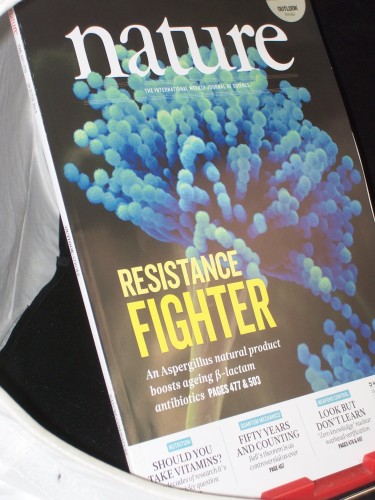
Policy: An intergovernmental panel on antimicrobial resistance
Drug-resistant microbes are spreading. A coordinated, global effort is needed to keep drugs working and develop alternatives, say Mark Woolhouse and Jeremy Farrar.
Health care: Bring microbial sequencing to hospitals
Analysing bacterial and viral DNA can help doctors to pick effective drugs quickly, says Sharon Peacock.
Cosmology: Matter and mixology
Francis Halzen is exhilarated by an account of the hunt for the particles of dark matter.
Review of The Cosmic Cocktail: Three Parts Dark Matter
Katherine Freese
Books in brief
Q&A: The space crusader
US astronomer Neil deGrasse Tyson, director of New York's Hayden Planetarium, currently hosts the television series Cosmos — an update of Carl Sagan's 1980 show — broadcast in 181 countries and 45 languages. As it winds down, Tyson talks about the rich mix of science and pop culture, the 'neurosynaptic snapshot' of public responses to his tweets, and his momentous meeting with Sagan.
Cancer
Herb Brody
Statistics: Attacking an epidemic
Mike May
Therapy: This time it's personal
Lauren Gravitz
Clinical trials: More trials, fewer tribulations
Michael Eisenstein
Nanotechnology: Deliver on a promise
Jessica Wright
Comparative biology: Naked ambition
Sarah Deweerdt
Prevention: Air of danger
Rebecca Kessler
Developing world: Global warning
Eric Bender
Bioinformatics: Big data versus the big C
Neil Savage
Perspective: Learning to share
John Quackenbush
Biology: Three known unknowns
Katherine Bourzac
Climate science: A sink down under
Daniel B. Metcalfe
See also
Letter by Poulter et al.
Microbiology: Barriers to the spread of resistance
Morten O. A. Sommer
See also
Letter by Forsberg et al.
Materials science: Energy storage wrapped up
Yury Gogotsi
50 & 100 Years Ago
Developmental genetics: Female silkworms have the sex factor
František Marec
See also
Letter by Kiuchi et al.
Precision measurement: The magnetic proton
V. Alan Kostelecký
See also
Letter by Mooser et al.
Cardiovascular biology: Switched at birth
Katherine E. Yutzey
Immunology: To affinity and beyond
David M. Tarlinton
See also
Letter by Gitlin et al.
Articles
Top
A draft map of the human proteome
Min-Sik Kim,
Sneha M. Pinto,
Derese Getnet,
Raja Sekhar Nirujogi,
Srikanth S. Manda
+ et al.
A draft map of the human proteome is presented here, accounting for over 80% of the annotated protein-coding genes in humans; some novel protein-coding regions, including translated pseudogenes, non-coding RNAs and upstream open reading frames, are identified.
Mass-spectrometry-based draft of the human proteome
Mathias Wilhelm,
Judith Schlegl,
Hannes Hahne,
Amin Moghaddas Gholami,
Marcus Lieberenz
+ et al.
A mass-spectrometry-based draft of the human proteome and a public database for analysis of proteome data are presented; assembled information is used to estimate the size of the protein-coding genome, to identify organ-specific proteins, proteins predicting drug resistance or sensitivity, and many translated long intergenic non-coding RNAs, and to reveal conserved control of protein abundance.
Structural basis of the non-coding RNA RsmZ acting as a protein sponge
Olivier Duss,
Erich Michel,
Maxim Yulikov,
Mario Schubert,
Gunnar Jeschke
+ et al.
A novel combined NMR and EPR spectroscopy approach reveals the structure and assembly mechanism of a 70-kDa bacterial ribonucleoprotein complex acting as a protein sponge in translational regulation.
Letters
Top
Three regimes of extrasolar planet radius inferred from host star metallicities
Lars A. Buchhave,
Martin Bizzarro,
David W. Latham,
Dimitar Sasselov,
William D. Cochran
+ et al.
Analysis of the metallicities of more than 400 stars hosting 600 candidate extrasolar planets shows that the planets can be categorized by size into three populations — terrestrial-like planets, gas dwarf planets with rocky cores and hydrogen–helium envelopes, and ice or gas giant planets — on the basis of host star metallicity.
Direct high-precision measurement of the magnetic moment of the proton
A. Mooser,
S. Ulmer,
K. Blaum,
K. Franke,
H. Kracke
+ et al.
The magnetic moment of the proton is directly measured with unprecedented precision using a double Penning trap.
See also
News & Views by Kostelecký
Contribution of semi-arid ecosystems to interannual variability of the global carbon cycle
Benjamin Poulter,
David Frank,
Philippe Ciais,
Ranga B. Myneni,
Niels Andela
+ et al.
The unusually large land carbon sink reported in 2011 can mostly be attributed to semi-arid vegetation growth in the Southern Hemisphere following increased rainfall and long-term greening trends.
See also
News & Views by Metcalfe
Storm-induced sea-ice breakup and the implications for ice extent
A. L. Kohout,
M. J. M. Williams,
S. M. Dean &
M. H. Meylan
Concurrent observations at multiple locations indicate that storm-generated ocean waves propagating through Antarctic sea ice can transport enough energy to break first-year sea ice hundreds of kilometres from the ice edge, which is much farther than would be predicted by the commonly assumed exponential wave decay.
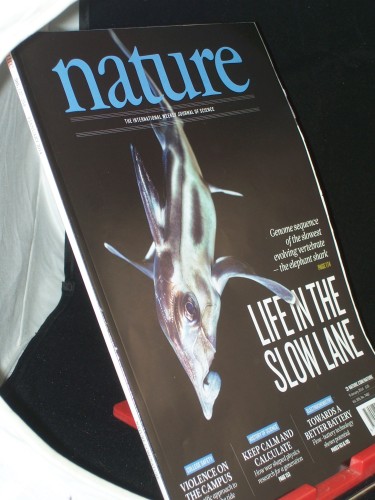
A Palaeozoic shark with osteichthyan-like branchial arches
Alan Pradel,
John G. Maisey,
Paul Tafforeau,
Royal H. Mapes &
Jon Mallatt
A description of the gill skeleton of a very early fossil shark-like fish shows that it bears more resemblance to gill skeletons from bony fishes rather than to those from modern cartilaginous fishes, suggesting that modern sharks are not anatomically primitive, as previously thought.
Bacterial phylogeny structures soil resistomes across habitats
Kevin J. Forsberg,
Sanket Patel,
Molly K. Gibson,
Christian L. Lauber,
Rob Knight
+ et al.
Functional metagenomic selections for resistance to 18 antibiotics in 18 different soils reveal that bacterial community composition is the primary determinant of soil antibiotic resistance gene content.
See also
News & Views by Sommer
Epidermal Merkel cells are mechanosensory cells that tune mammalian touch receptors
Srdjan Maksimovic,
Masashi Nakatani,
Yoshichika Baba,
Aislyn M. Nelson,
Kara L. Marshall
+ et al.
The cellular basis of touch has long been debated, in particular the relationship between sensory neurons and non-neuronal cells; a mouse study uses optogenetics to identify their distinct and collaborative roles, with skin-derived Merkel cells both transducing touch and actively tuning responses of touch-sensitive neurons.
Piezo2 is required for Merkel-cell mechanotransduction
Seung-Hyun Woo,
Sanjeev Ranade,
Andy D. Weyer,
Adrienne E. Dubin,
Yoshichika Baba
+ et al.
A mouse study shows that non-neuronal epidermal Merkel cells aid fine-touch perception in the skin through their expression of the Piezo2 mechanosensitive cation channel which then actively tunes the response to touch in adjacent somatosensory neurons.
Scalable control of mounting and attack by Esr1+ neurons in the ventromedial hypothalamus
Hyosang Lee,
Dong-Wook Kim,
Ryan Remedios,
Todd E. Anthony,
Angela Chang
+ et al.
Activation of Esr1+ neurons of the mouse ventromedial hypothalamus initiates graded social behavioural responses–weak activation triggers close investigation (sniffing) during a social encounter that often leads, with continued stimulation, to mounting behaviours by males towards either gender; mounting behaviour transitions to aggressive attacks with greater stimulation intensity.
A single female-specific piRNA is the primary determiner of sex in the silkworm
Takashi Kiuchi,
Hikaru Koga,
Munetaka Kawamoto,
Keisuke Shoji,
Hiroki Sakai
+ et al.
It is known that in the silkworm (Bombyx mori), males have two Z sex chromosomes whereas females have Z and W and the W chromosome has a dominant role in female determination; here a single female-specific W-chromosome-derived PIWI-interacting RNA is shown to be the feminizing factor in B. mori.
See also
News & Views by Marec
Clonal selection in the germinal centre by regulated proliferation and hypermutation
Alexander D. Gitlin,
Ziv Shulman &
Michel C. Nussenzweig
Clonal expansion and hypermutation of B cells in the germinal centre are regulated by the amount of antigen that the B cells present to follicular helper T cells.
See also
News & Views by Tarlinton
Dichloroacetate prevents restenosis in preclinical animal models of vessel injury
Tobias Deuse,
Xiaoqin Hua,
Dong Wang,
Lars Maegdefessel,
Joerg Heeren
+ et al.
During development of myointimal hyperplasia in human arteries, smooth muscle cells have hyperpolarized mitochondrial membrane potential (ΔΨm), high proliferation and apoptosis resistance; PDK2 is a key regulatory protein whose activation is necessary for myointima formation, and its blockade with dichloroacetate prevents Δψm hyperpolarization, facilitates apoptosis and reduces myointima formation in injured arteries, without preventing vessel re-endothelialization, possibly representing a novel strategy to prevent proliferative vascular diseases.
gepflegtes Exemplar, nur kleine Lesespuren
- Verlag:
- NPG Nature publishing group
- Englische Ausgabe
- Artikelnummer:
- B00042577
- Gewicht:
- 400 gr
- Lagerplatz:
- Z7_4_18