Medical research: Missing patients
Effective clinical studies must consider all ethnicities — exclusion can endanger populations, says Esteban G. Burchard.
Developing world: Discuss inequality
Confront economic differences to strengthen global research, urge P. Wenzel Geissler and Ferdinand Okwaro.
Mental health: Tailor informed-consent processes
The first step in studying mental-health interventions across cultures is to adjust procedures to participants' needs, says Mónica Ruiz-Casares.
Collaboration: Strength in diversity
Richard B. Freeman and Wei Huang reflect on a link between a team's ethnic mix and highly cited papers.
Genetics: Under the skin
Nathaniel Comfort wonders at the enduring trend of misrepresenting race.
Review of A Troublesome Inheritance: Genes, Race and Human History, Race Unmasked: Biology and Race in the 20th Century & The Myth of Race: The Troubling Persistence of an Unscientific Idea
Nicholas Wade, Michael Yudell & Robert Wald Sussman
Physics: In thrall to uncertainty
A history of how quantum theory has permeated Western culture refreshes Jim Baggott.
Review of The Quantum Moment: How Planck, Bohr, Einstein, and Heisenberg Taught Us to Love Uncertainty
Robert P. Crease & Alfred Scharff Goldhaber
New in paperback
Linguistics: The write stuff
Steven Pinker's provocative treatise on language use and abuse would benefit from more data, finds Paul Raeburn.
Review of The Sense of Style: The Thinking Person's Guide to Writing in the 21st Century
Steven Pinker
Evolution: Tribes like us
Tim Lenton is intrigued by E. O. Wilson's sweeping perspective on humanity's past — and possible futures.
Review of The Meaning of Human Existence
Edward O. Wilson
Climate policy: A societal sea change
Nico Stehr ponders Naomi Klein's call for strategic mass action on climate change.
Review of This Changes Everything: Capitalism vs the Climate
Naomi Klein
Internet: Technology and its discontents
Jaron Lanier surveys four studies probing the vexed nexus of mind and digisphere.
Review of Mind Change: How Digital Technologies Are Leaving Their Mark on Our Brains, The Organized Mind: Thinking Straight in the Age of Information Overload, The Impulse Society: What's Wrong With Getting What We Want? & The Glass Cage: Automation and Us
Susan Greenfield, Daniel J. Levitin, Paul Roberts & Nicholas Carr
When disease strikes from nowhere
When healthy parents have a child with a genetic disorder, the cause is sometimes a new mutation. Tools are emerging to meet the challenge of finding such changes.
Insight: Exoplanets
Exoplanets
Leslie Sage
Doppler spectroscopy as a path to the detection of Earth-like planets
Michel Mayor,
Christophe Lovis &
Nuno C. Santos
See also
Insight by Lissauer et al.
See also
Insight by Pepe et al.
Advances in exoplanet science from Kepler
Jack J. Lissauer,
Rebekah I. Dawson &
Scott Tremaine
Highlights in the study of exoplanet atmospheres
Adam S. Burrows
The role of space telescopes in the characterization of transiting exoplanets
Artie P. Hatzes
See also
Insight by Lissauer et al.
Instrumentation for the detection and characterization of exoplanets
Francesco Pepe,
David Ehrenreich &
Michael R. Meyer
See also
Insight by Mayor et al.
GATM locus does not replicate in rhabdomyolysis study
James S. Floyd,
Joshua C. Bis,
Jennifer A. Brody,
Susan R. Heckbert,
Kenneth Rice
+ et al.
Mangravite et al. reply
Lara M. Mangravite,
Barbara E. Engelhardt,
Matthew Stephens &
Ronald M. Krauss
News & Views
Top
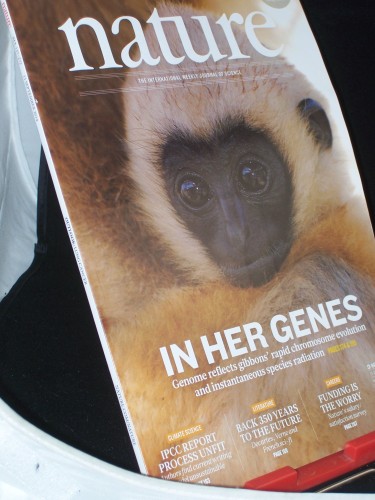
Evolutionary biology: Radiating genomes
Chris D. Jiggins
See also
Article by Brawand et al.
Condensed-matter physics: Catching relativistic electrons
Zhihuai Zhu &
Jennifer E. Hoffman
Animal behaviour: The evolutionary roots of lethal conflict
Joan B. Silk
See also
Letter by Wilson et al.
Astrophysics: Giant black hole in a stripped galaxy
Amy E. Reines
See also
Letter by Seth et al.
50 & 100 Years Ago
Neuroscience: Shedding light on a change of mind
Tomonori Takeuchi &
Richard G. M. Morris
See also
Letter by Redondo et al.
Organic chemistry: Reactivity tamed one bond at a time
Matthew T. Villaume &
Phil S. Baran
See also
Article by Meng et al.
Articles
Top
Multifunctional organoboron compounds for scalable natural product synthesis
Fanke Meng,
Kevin P. McGrath &
Amir H. Hoveyda
A catalytic process is reported that begins with a highly selective copper–boron addition to a monosubstituted allene, and in which the resulting boron-substituted organocopper intermediate then participates in a chemoselective, site-selective and enantioselective allylic substitution; this approach is used in the enantioselective synthesis of gram quantities of two natural products.
See also
News & Views by Villaume & Baran
The genomic substrate for adaptive radiation in African cichlid fishOpen
David Brawand,
Catherine E. Wagner,
Yang I. Li,
Milan Malinsky,
Irene Keller
+ et al.
Genomes and transcriptomes of five distinct lineages of African cichlids, a textbook example of adaptive radiation, have been sequenced and analysed to reveal that many types of molecular changes contributed to rapid evolution, and that standing variation accumulated during periods of relaxed selection may have primed subsequent diversification.
See also
News & Views by Jiggins
Proteogenomic characterization of human colon and rectal cancer
Bing Zhang,
Jing Wang,
Xiaojing Wang,
Jing Zhu,
Qi Liu
+ et al.
Proteome analysis of The Cancer Genome Atlas (TCGA) colorectal cancer specimens reveals that DNA- or RNA-level measurements cannot reliably predict protein abundance, colorectal tumours can be separated into distinct proteotypes, and that copy number alterations drive mRNA abundance changes but few extend to protein-level changes.
Molecular architecture and mechanism of the anaphase-promoting complex
Leifu Chang,
Ziguo Zhang,
Jing Yang,
Stephen H. McLaughlin &
David Barford
The anaphase-promoting complex/cyclosome (APC/C) is a large E3 ligase that mediates ubiquitin-dependent proteolysis of cell cycle regulatory proteins; here the complete secondary structure architecture of human APC/C complexed with its coactivator CDH1 and substrate HSL1 is determined at 7.4 Å resolution, revealing allosteric changes induced by the coactivator that enhance affinity for UBCH10–ubiqutin.
Letters
Top
A massive galaxy in its core formation phase three billion years after the Big Bang
Erica Nelson,
Pieter van Dokkum,
Marijn Franx,
Gabriel Brammer,
Ivelina Momcheva
+ et al.
Hubble Space Telescope, Keck telescope and Spitzer satellite data reveal the formation of the dense stellar core of a massive galaxy occurring three billion years after the Big Bang.
A supermassive black hole in an ultra-compact dwarf galaxy
Anil C. Seth,
Remco van den Bosch,
Steffen Mieske,
Holger Baumgardt,
Mark den Brok
+ et al.
Dynamical modelling of the ultra-compact dwarf galaxy M60-UCD1 reveals the presence of a supermassive black hole; this suggests the object is a stripped galaxy nucleus and implies the existence of supermassive black holes in many other ultra-compact dwarf galaxies.
See also
News & Views by Reines
Aridification of the Sahara desert caused by Tethys Sea shrinkage during the Late Miocene
Zhongshi Zhang,
Gilles Ramstein,
Mathieu Schuster,
Camille Li,
Camille Contoux
+ et al.
The drying of the Tethys Sea—the progenitor of the modern Mediterranean, Black and Caspian seas—weakened the northern extension of the African monsoon and led to the creation of the Sahara desert about 7 million years ago.
Spreading continents kick-started plate tectonics
Patrice F. Rey,
Nicolas Coltice &
Nicolas Flament
The slow gravitational collapse of early continents could have kick-started transient episodes of plate tectonics until, as the Earth’s interior cooled and oceanic lithosphere became heavier, plate tectonics became self-sustaining.
Ancient human genomes suggest three ancestral populations for present-day Europeans
A list of authors and their affiliations appears at the end of the paper
A sequencing study comparing ancient and contemporary genomes reveals that most present-day Europeans derive from at least three highly differentiated populations: west European hunter-gatherers, ancient north Eurasians (related to Upper Palaeolithic Siberians) and early European farmers of mainly Near Eastern origin.
Lethal aggression in Pan is better explained by adaptive strategies than human impacts
Michael L. Wilson,
Christophe Boesch,
Barbara Fruth,
Takeshi Furuichi,
Ian C. Gilby
+ et al.
A meta-analysis of studies on chimpanzees and bonobos across Africa shows that their conspecific aggression is the normal and expected product of adaptive strategies to obtain resources or mates and has no connection with the impacts of human activities.
See also
News & Views by Silk
Optimization of lag time underlies antibiotic tolerance in evolved bacterial populations
Ofer Fridman,
Amir Goldberg,
Irine Ronin,
Noam Shoresh &
Nathalie Q. Balaban
Repeated exposure of the bacterium Escherichia coli to clinically relevant concentrations of ampicillin results in the evolution of tolerance—the ability to survive until the antibiotic concentration diminishes—through an extension of the lag phase, a finding that has implications for slowing the evolution of antibiotic resistance.
Genome sequencing of normal cells reveals developmental lineages and mutational processes
Sam Behjati,
Meritxell Huch,
Ruben van Boxtel,
Wouter Karthaus,
David C. Wedge
+ et al.
On the basis of whole-genome sequences of clonal lines derived from normal mouse tissues, variation in mutational patterns and load across different tissues are described and early embryonic cell divisions are reconstructed.
Bidirectional switch of the valence associated with a hippocampal contextual memory engram
Roger L. Redondo,
Joshua Kim,
Autumn L. Arons,
Steve Ramirez,
Xu Liu
+ et al.
An optogenetic approach in mice was used to investigate the neural mechanisms underlying memory valence association; dentate gyrus, but not amygdala, memory engram cells exhibit plasticity in valence associations, suggesting that emotional memory associations can be changed at the circuit level.
See also
News & Views by Takeuchi & Morris
Exonuclease-mediated degradation of nascent RNA silences genes linked to severe malaria
Qingfeng Zhang,
T. Nicolai Siegel,
Rafael M. Martins,
Fei Wang,
Jun Cao
+ et al.
A novel type of post-transcriptional regulation controls the expression of virulence genes in blood-stage malaria parasites.
Endocrinization of FGF1 produces a neomorphic and potent insulin sensitizer
Jae Myoung Suh,
Johan W. Jonker,
Maryam Ahmadian,
Regina Goetz,
Denise Lackey
+ et al.
Pharmacological fibroblast growth factor 1 (FGF1) normalizes blood glucose in diabetic mice by means of an FGF receptor signalling pathway that is independent of its mitogenic activity.
Coordinated regulation of protein synthesis and degradation by mTORC1
Yinan Zhang,
Justin Nicholatos,
John R. Dreier,
Stéphane J. H. Ricoult,
Scott B. Widenmaier
+ et al.
mTORC1 is known to stimulate protein synthesis; now, it is shown to also promote the synthesis of proteasomes, which degrade proteins into the amino acids needed to create new proteins.
gepflegtes Exemplar, nur kleine Lesespuren
- Verlag:
- NPG Nature publishing group
- Englische Ausgabe
- Artikelnummer:
- B00042585
- Gewicht:
- 400 gr
- Lagerplatz:
- Z7_4_18