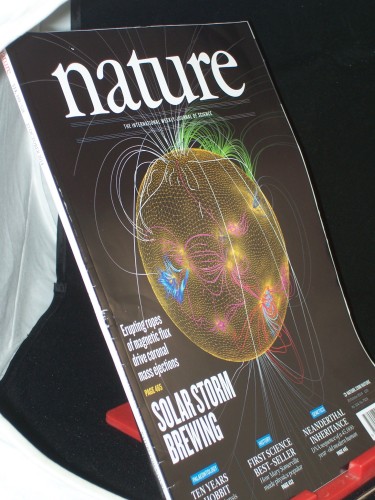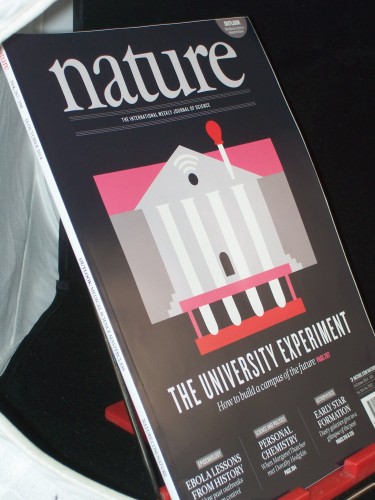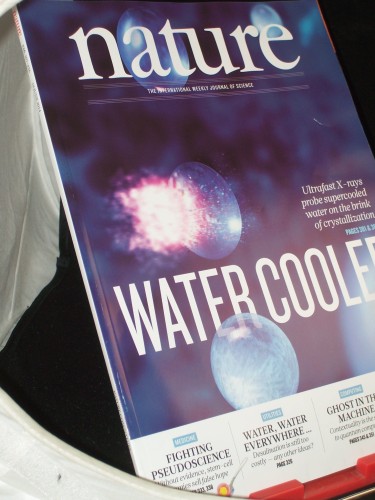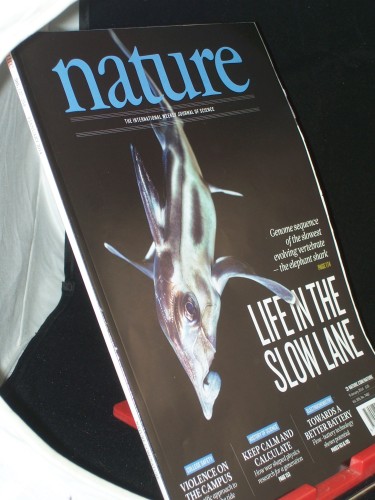
Mental health: A road map for suicide research and prevention
It is time for policy-makers, funders, researchers and clinicians to tackle high suicide rates, say André Aleman and Damiaan Denys.
Evolutionary biology: Darwin and the women
Sarah S. Richardson relishes a study of how nineteenth-century US feminists used the biologist's ideas.
Review of From Eve to Evolution: Darwin, Science, and Women's Rights in Gilded Age America
Kimberly A. Hamlin
Information technology: Forgotten prophet of the Internet
Philip Ball ponders the tale of a librarian who dreamed of networking information.
Review of Cataloging the World: Paul Otlet and the Birth of the Information Age
Alex Wright
European pollution: Investigate smog to inform policy
Paul S. Monks
Databases: Soil observatory lets researchers dig deep
Russell Lawley,
Bridget A. Emmett &
David A. Robinson
Health care: Strict vaccine quality control in China
Zhenglun Liang,
Qunying Mao &
Junzhi Wang
Political ecology: Rethink Campania's toxic-waste scandal
Giacomo D'Alisa,
Marco Armiero &
Salvatore Paolo De Rosa
Technology: Internal factors drive Chinese patent surge
Ching-Yan Wu,
Mei-Chih Hu &
John A. Mathews
Epigenetics: Keeping one's sex
Douglas L. Chalker
See also
Article by Singh et al.
Astrophysics: Windy stars that go with a bang
John J. Eldridge
See also
Letter by Gal-Yam et al.
Physiology: Double function at the blood–brain barrier
Christer Betsholtz
See also
Letter by Nguyen et al.
See also
Letter by Ben-Zvi et al.
Materials chemistry: Selectivity from flexibility
Ryotaro Matsuda
Cancer: Darwinian tumour suppression
Eduardo Moreno
See also
Article by Martins et al.
Earth science: Fertile fields for seismicity
Paul Lundgren
See also
Letter by Amos et al.
Articles
Top
Genome-defence small RNAs exapted for epigenetic mating-type inheritance
Deepankar Pratap Singh,
Baptiste Saudemont,
Gérard Guglielmi,
Olivier Arnaiz,
Jean-François Goût
+ et al.
The molecular basis for mating-type determination in the ciliate Paramecium has been elucidated, revealing a novel function for a class of small RNAs — these scnRNAs are typically involved in reprogramming the Paramecium genome during sexual reproduction by recognizing and excising transposable elements, but they are now found to be co-opted to switch off expression of the newly identified mating-type gene mtA by excising its promoter, and to mediate epigenetic inheritance of mating types across sexual generations.
See also
News & Views by Chalker
Amygdala interneuron subtypes control fear learning through disinhibition
Steffen B. E. Wolff,
Jan Gründemann,
Philip Tovote,
Sabine Krabbe,
Gilad A. Jacobson
+ et al.
Plasticity within neuronal microcircuits is believed to be the substrate of learning, and this study identifies two distinct disinhibitory mechanisms involving interactions between PV+ and SOM+ interneurons that dynamically regulate principal neuron activity in the amygdala and thereby control auditory fear learning.
Contrasting forms of cocaine-evoked plasticity control components of relapse
Vincent Pascoli,
Jean Terrier,
Julie Espallergues,
Emmanuel Valjent,
Eoin Cornelius O’Connor
+ et al.
Information integration in the nucleus accumbens is commandeered by cocaine at discrete synapses to allow relapse.
Cell competition is a tumour suppressor mechanism in the thymus
Vera C. Martins,
Katrin Busch,
Dilafruz Juraeva,
Carmen Blum,
Carolin Ludwig
+ et al.
T cells develop from thymic precursor cells that are constantly replaced with newly arriving bone marrow progenitor cells, and the ‘old’ and ‘new’ cells are shown here to compete; in the absence of cell competition, when the influx of new bone marrow progenitor cells is blocked, the old cells acquire the ability to self-renew and eventually become transformed, leading to the development of a form of leukaemia.
See also
News & Views by Moreno
Letters
Top
A Wolf–Rayet-like progenitor of SN 2013cu from spectral observations of a stellar wind
Avishay Gal-Yam,
I. Arcavi,
E. O. Ofek,
S. Ben-Ami,
S. B. Cenko
+ et al.
The detection of strong emission lines in an early-time spectrum of type IIb supernova SN 2013cu reveals Wolf–Rayet-like wind signatures, suggesting that the supernova’s progenitor may have been a Wolf–Rayet star with a wind dominated by helium and nitrogen, with traces of hydrogen.
See also
News & Views by Eldridge
Practical quantum key distribution protocol without monitoring signal disturbance
Toshihiko Sasaki,
Yoshihisa Yamamoto &
Masato Koashi
Conventional quantum cryptography relies on monitoring signal disturbance to make sure that information leakage is negligible; here a new quantum method of achieving security is described, in which little information is leaked to the eavesdropper regardless of the signal disturbance.
Future increases in Arctic precipitation linked to local evaporation and sea-ice retreat
R. Bintanja &
F. M. Selten
Precipitation is expected to increase far more over the twenty-first century in the Arctic than the global average; climate models show that this is driven mainly by increased local evaporation and sea-ice retreat, rather than by increased moisture transport from lower latitudes.
Uplift and seismicity driven by groundwater depletion in central California
Colin B. Amos,
Pascal Audet,
William C. Hammond,
Roland Bürgmann,
Ingrid A. Johanson
+ et al.
Human-caused groundwater depletion in California’s San Joaquin Valley contributes to uplift of the surrounding mountains and may affect the stability of the San Andreas Fault.
See also
News & Views by Lundgren
High-throughput screening of a CRISPR/Cas9 library for functional genomics in human cells
Yuexin Zhou,
Shiyou Zhu,
Changzu Cai,
Pengfei Yuan,
Chunmei Li
+ et al.
This study describes the construction of a focused CRISPR/Cas-based lentiviral library in human cells and a method of gene identification based on functional screening and high-throughput sequencing analysis.
Copper is required for oncogenic BRAF signalling and tumorigenesis
Donita C. Brady,
Matthew S. Crowe,
Michelle L. Turski,
G. Aaron Hobbs,
Xiaojie Yao
+ et al.
Tumorigenesis driven by the oncogene BRAFV600E is shown both to depend on the BRAF substrates MEK1/2 associating with copper, and to be sensitive to copper-chelating drugs, suggesting merit in testing such drugs for the treatment of BRAF mutation-positive cancers.
Protective mucosal immunity mediated by epithelial CD1d and IL-10
Torsten Olszak,
Joana F. Neves,
C. Marie Dowds,
Kristi Baker,
Jonathan Glickman
+ et al.
Here, the presentation of lipid antigens by CD1d is shown to induce retrograde anti-inflammatory signalling in intestinal epithelial cells, resulting in the production of IL-10.
Mfsd2a is a transporter for the essential omega-3 fatty acid docosahexaenoic acid
Long N. Nguyen,
Dongliang Ma,
Guanghou Shui,
Peiyan Wong,
Amaury Cazenave-Gassiot
+ et al.
Mfsd2a is the major transporter of the omega-3 fatty acid docosahexaenoic acid (DHA) into brain, with Mfsd2a-knockout mice showing reduced DHA in brain, neuronal cell loss in hippocampus and cerebellum, behavioural disorders and reduced brain size; DHA is transported in a sodium-dependent manner, in the form of lysophosphatidylcholines (LPCs) carrying long-chain fatty acids.
See also
News & Views by Betsholtz
Mfsd2a is critical for the formation and function of the blood–brain barrier
Ayal Ben-Zvi,
Baptiste Lacoste,
Esther Kur,
Benjamin J. Andreone,
Yoav Mayshar
+ et al.
Mfsd2a is a key regulator of blood–brain barrier (BBB) formation and function in mice: Mfsd2a is selectively expressed in BBB-containing blood vessels in the CNS; Mfsd2a−/− mice have a leaky BBB and increased vesicular transcytosis in CNS endothelial cells; and Mfsd2a endothelial expression is regulated by pericytes to facilitate BBB integrity.
See also
News & Views by Betsholtz
Structure of the AcrAB–TolC multidrug efflux pump
Dijun Du,
Zhao Wang,
Nathan R. James,
Jarrod E. Voss,
Ewa Klimont
+ et al.
Many bacteria are able to survive in the presence of antibiotics in part because they possess pumps that can remove a broad range of small molecules; here, the structure of one such pump, AcrAB–TolC, is determined using X-ray crystallography and cryo-electron microscopy.
Structural basis of Sec-independent membrane protein insertion by YidC
Kaoru Kumazaki,
Shinobu Chiba,
Mizuki Takemoto,
Arata Furukawa,
Ken-ichi Nishiyama
+ et al.
The crystal structure of the bacterial protein YidC is reported, together with a structure-based functional analysis, providing insight into the role of YidC in inserting single-spanning membrane proteins into the membrane.
gepflegtes Exemplar, nur kleine Lesespuren
- Verlag:
- NPG Nature publishing group
- Englische Ausgabe
- Artikelnummer:
- B00042576
- Gewicht:
- 400 gr
- Lagerplatz:
- Z7_4_18