Climate science: Understand Arctic methane variability
Expand ground monitoring of polar sources of this greenhouse gas to find out how climate change will influence its release, says Torben R. Christensen.
Policy: NIH to balance sex in cell and animal studies
Janine A. Clayton and Francis S. Collins unveil policies to ensure that preclinical research funded by the US National Institutes of Health considers females and males.
Sociobiology: The distributed brain
Herbert Gintis salutes the follow-up to a study on sociality and hominin brain size.
Review of Thinking Big: How the Evolution of Social Life Shaped the Human Mind
Clive Gamble, John Gowlett & Robin Dunbar
Books in brief
Chemistry: Intoxicating science
Jamie Goode drinks in two views of that most venerable and destructive drug — alcohol.
Review of Proof: The Science of Booze & The Drunken Monkey: Why We Drink and Abuse Alcohol
Adam Rogers & Robert Dudley
Development: Dammed dreams
Monya Baker is swept along by a documentary film tracing humanity's complex relationship with water.
Review of Watermark
Edward Burtynsky & Jennifer Baichwal
Climate science: Shifting storms
Hamish Ramsay
See also
Letter by Kossin et al.
Synthetic biology: New letters for life's alphabet
Ross Thyer &
Jared Ellefson
See also
Letter by Malyshev et al.
Organic chemistry: Collaborative synthesis
John L. Wood
See also
Article by Mercado-Marin et al.
Neurobiology: To care or not to care
Ivan Rodriguez
See also
Article by Wu et al.
50 & 100 Years Ago
Sensory biology: Radio waves zap the biomagnetic compass
Joseph L. Kirschvink
See also
Letter by Engels et al.
Evolution: Geology and climate drive diversification
Rosemary G. Gillespie &
George K. Roderick
Articles
Top
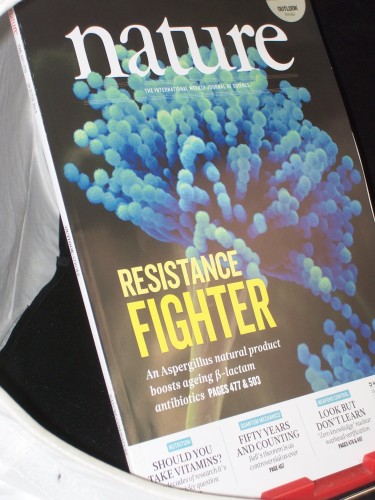
Total synthesis and isolation of citrinalin and cyclopiamine congeners
Eduardo V. Mercado-Marin,
Pablo Garcia-Reynaga,
Stelamar Romminger,
Eli. F. Pimenta,
David K. Romney
+ et al.
Natural products citrinalin B and cyclopiamine B, which contain basic nitrogen atoms that are susceptible to oxidation during synthesis, can be synthesized by the selective introduction and removal of functional groups.
See also
News & Views by Wood
Galanin neurons in the medial preoptic area govern parental behaviour
Zheng Wu,
Anita E. Autry,
Joseph F. Bergan,
Mitsuko Watabe-Uchida &
Catherine G. Dulac
Sexual experience brings radical changes in how male mice behave with pups—virgin males attack them whereas mature fathers display parental care; here the authors identify a subset of hypothalamic neurons whose ablation leads to parental deficits in both males and females, and whose activation in virgin males suppresses aggression and induces pup grooming.
See also
News & Views by Rodriguez
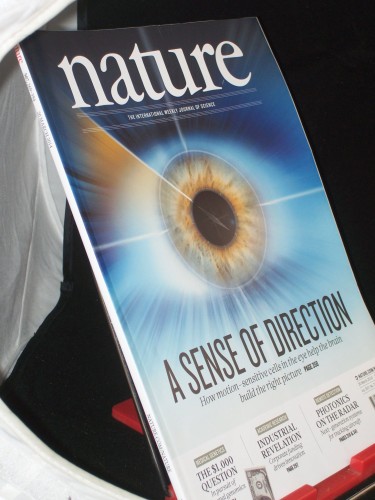
Space–time wiring specificity supports direction selectivity in the retina
Jinseop S. Kim,
Matthew J. Greene,
Aleksandar Zlateski,
Kisuk Lee,
Mark Richardson
+ et al.
Motion detection by the retina is thought to rely largely on the biophysics of starburst amacrine cell dendrites; here machine learning is used with gamified crowdsourcing to draw the wiring diagram involving amacrine and bipolar cells to identify a plausible circuit mechanism for direction selectivity; the model suggests similarities between mammalian and insect vision.
c-kit+ cells minimally contribute cardiomyocytes to the heart
Jop H. van Berlo,
Onur Kanisicak,
Marjorie Maillet,
Ronald J. Vagnozzi,
Jason Karch
+ et al.
Whether or not endogenous c-kit+ cells residing within the heart contribute cardiomyocytes during physiological ageing or after injury remains unknown; here, using an inducible lineage tracing system, the c-kit+ lineage is shown to generate cardiomyocytes at very low levels, and, by contrast, contributes substantially to cardiac endothelial cell generation.
Letters
Top
Cepheid variables in the flared outer disk of our galaxy
Michael W. Feast,
John W. Menzies,
Noriyuki Matsunaga &
Patricia A. Whitelock
Five classical Cepheids have been detected in the outer parts of our Galaxy beyond the Galactic bulge; they are probably associated with the gas in the flared disk and, if so, they are the first stars to be identified in the flare.
Tracking excited-state charge and spin dynamics in iron coordination complexes
Wenkai Zhang,
Roberto Alonso-Mori,
Uwe Bergmann,
Christian Bressler,
Matthieu Chollet
+ et al.
Femtosecond resolution X-ray fluorescence spectroscopy is shown to track the charge and spin dynamics triggered when an iron coordination complex is excited by light, and establishes the critical role of intermediate spin states in the de-excitation process.
The poleward migration of the location of tropical cyclone maximum intensity
James P. Kossin,
Kerry A. Emanuel &
Gabriel A. Vecchi
Analysis of global historical data in the Northern and Southern hemispheres reveals a statistically significant, poleward migration of 1° per decade in the average latitude at which tropical cyclones have achieved their lifetime-maximum intensity over the past 30 years.
See also
News & Views by Ramsay
Anthropogenic electromagnetic noise disrupts magnetic compass orientation in a migratory bird
Svenja Engels,
Nils-Lasse Schneider,
Nele Lefeldt,
Christine Maira Hein,
Manuela Zapka
+ et al.
For the first time under reproducible and fully double-blinded conditions, it is shown that anthropogenic electromagnetic noise below the WHO limits affects a biological system: night-migrating birds lose the ability to use the Earth’s magnetic field for orientation when exposed to anthropogenic electromagnetic noise at strengths routinely produced by commonly used electronic devices.
See also
News & Views by Kirschvink
Dynamics and associations of microbial community types across the human body
Tao Ding &
Patrick D. Schloss
The microbiome composition of 300 individuals sampled over 12–18 months was partitioned into microbial community types, which could be associated with the type found at other body sites, as well as with whether individuals were breastfed as an infant, their gender and their level of education.
T-cell activation by transitory neo-antigens derived from distinct microbial pathways
Alexandra J. Corbett,
Sidonia B. G. Eckle,
Richard W. Birkinshaw,
Ligong Liu,
Onisha Patel
+ et al.
Activation of mucosal-associated invariant T (MAIT) cells is shown to require key genes encoding an early intermediate in bacterial riboflavin synthesis, 5-amino-6-d-ribitylaminouracil; this reacts non-enzymatically with metabolites to form short-lived antigens that are captured and stabilized by MR1 for presentation to MAIT cells.
Caspase-11 activation requires lysis of pathogen-containing vacuoles by IFN-induced GTPases
Etienne Meunier,
Mathias S. Dick,
Roland F. Dreier,
Nura Schürmann,
Daniela Kenzelmann Broz
+ et al.
Interferon-inducible GTPases are required for the release of vacuolar Gram-negative bacteria into the cytoplasm and subsequent inflammasome-mediated caspase-11 activation.
Reconstructing lineage hierarchies of the distal lung epithelium using single-cell RNA-seq
Barbara Treutlein,
Doug G. Brownfield,
Angela R. Wu,
Norma F. Neff,
Gary L. Mantalas
+ et al.
Single-cell transcriptome analysis enables the direct measurement of cell types and lineage hierarchies of the developing distal lung epithelium and identifies a population of bipotential alveolar progenitor cells.
Disruption of Mediator rescues the stunted growth of a lignin-deficient Arabidopsis mutant
Nicholas D. Bonawitz,
Jeong Im Kim,
Yuki Tobimatsu,
Peter N. Ciesielski,
Nickolas A. Anderson
+ et al.
Disruption of lignin biosynthesis has been proposed as a way to improve forage and bioenergy crops, but it can result in stunted growth and developmental abnormalities; here, the undesirable features of one such manipulation are shown to depend on the transcriptional co-regulatory complex Mediator.
Structure of the core ectodomain of the hepatitis C virus envelope glycoprotein 2
Abdul Ghafoor Khan,
Jillian Whidby,
Matthew T. Miller,
Hannah Scarborough,
Alexandra V. Zatorski
+ et al.
The crystal structure of the core domain of the hepatitis C virus surface glycoprotein E2 has been solved; the structure shows that, contrary to expectation, E2 is unlikely to be the viral fusion protein.
A semi-synthetic organism with an expanded genetic alphabet
Denis A. Malyshev,
Kirandeep Dhami,
Thomas Lavergne,
Tingjian Chen,
Nan Dai
+ et al.
Triphosphates of hydrophobic nucleotides d5SICS and dNaM are imported into Escherichia coli by an exogenous algal nucleotide triphosphate transporter and then used by an endogenous polymerase to replicate, and faithfully maintain over many generations of growth, a plasmid containing the d5SICS–dNaM unnatural base pair.
See also
News & Views by Thyer & Ellefson
gepflegtes Exemplar, nur kleine Lesespuren
- Verlag:
- NPG Nature publishing group
- Englische Ausgabe
- Artikelnummer:
- B00042572
- Gewicht:
- 400 gr
- Lagerplatz:
- Z7_4_17