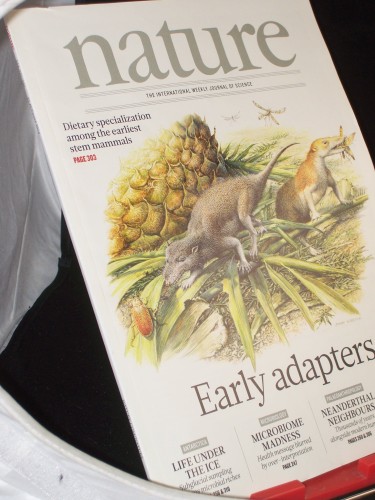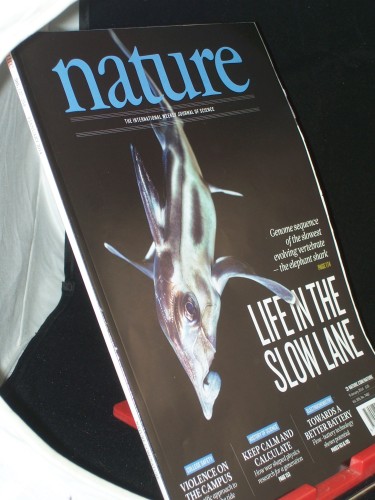
Physics: QBism puts the scientist back into science
A participatory view of science resolves quantum paradoxes and finds room in classical physics for 'the Now', says N. David Mermin.
Preclinical research: Make mouse studies work
More investment to characterize animal models can boost the ability of preclinical work to predict drug effects in humans, says Steve Perrin.
In Retrospect: The Social Function of Science
Roger Pielke Jr assesses the legacy of J. D. Bernal's science-policy classic on its 75th anniversary.
Review of The Social Function of Science
J. D. Bernal
Microbiology: Majority rule
Mark O. Martin relishes a stimulating tour of 'little lives', from fungi to bacteria.
Review of The Amoeba in the Room: Lives of the Microbes
Nicholas P. Money
Books in brief
Mathematics: Numbers game
George Szpiro enjoys a history of the slow but irresistible rise of mathematical symbols.
Review of Enlightening Symbols: A Short History of Mathematical Notation and Its Hidden Powers
Joseph Mazur
Neuroscience: Updating views of visual updating
John A. Assad
See also
Letter by Zirnsak et al.
Solar System: Stranded in no-man's-land
Megan E. Schwamb
See also
Letter by Trujillo & Sheppard
Biogeochemistry: Methane minimalism
Tori M. Hoehler &
Marc J. Alperin
See also
Letter by Yvon-Durocher et al.
Climate science: A high bar for decadal forecasts of El Niño
Pedro DiNezio
Alzheimer's disease: A protective factor for the ageing brain
Li-Huei Tsai &
Ram Madabhushi
See also
Article by Lu et al.
Low-temperature physics: Chaos in the cold
Paul S. Julienne
See also
Letter by Frisch et al.
Osteoarthritis: The zinc link
Virginia Byers Kraus
Perspectives
Top
The ultimate physical limits of privacy
Artur Ekert &
Renato Renner
Developments in quantum cryptography show that it is possible to protect secrets — from those with superior technology, those who profess to provide our security and even those who manipulate us without our knowledge — under surprisingly weak assumptions.
Articles
Top
REST and stress resistance in ageing and Alzheimer’s disease
Tao Lu,
Liviu Aron,
Joseph Zullo,
Ying Pan,
Haeyoung Kim
+ et al.
REST, a developmental regulator, is markedly induced in human neurons during ageing but is lost in Alzheimer’s disease; REST represses genes that promote neurodegeneration, is neuroprotective in animal models, and is associated with cognitive preservation and longevity in humans.
See also
News & Views by Tsai & Madabhushi
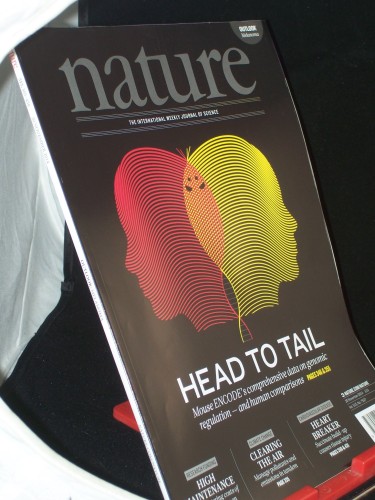
An atlas of active enhancers across human cell types and tissues
Robin Andersson,
Claudia Gebhard,
Irene Miguel-Escalada,
Ilka Hoof,
Jette Bornholdt
+ et al.
Using the FANTOM5 CAGE expression atlas, the authors show that bidirectional capped RNAs are a signature feature of active enhancers and identify over 40,000 enhancer candidates from over 800 human cell and tissue samples across the whole human body.
A promoter-level mammalian expression atlas
The FANTOM Consortium and the RIKEN PMI and CLST (DGT)
A study from the FANTOM consortium using single-molecule cDNA sequencing of transcription start sites and their usage in human and mouse primary cells, cell lines and tissues reveals insights into the specificity and diversity of transcription patterns across different mammalian cell types.
Letters
Top
A Sedna-like body with a perihelion of 80 astronomical units
Chadwick A. Trujillo &
Scott S. Sheppard
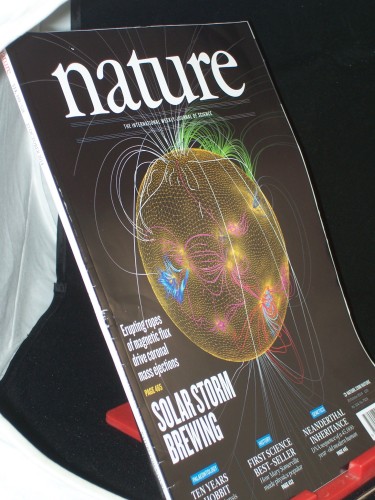
The discovery of the distant dwarf planet 2012 VP113, with its large perihelion like that of the dwarf planet Sedna, shows that Sedna is not isolated and may be part of the putative massive inner Oort cloud, which extends far beyond the observable Solar System.
See also
News & Views by Schwamb
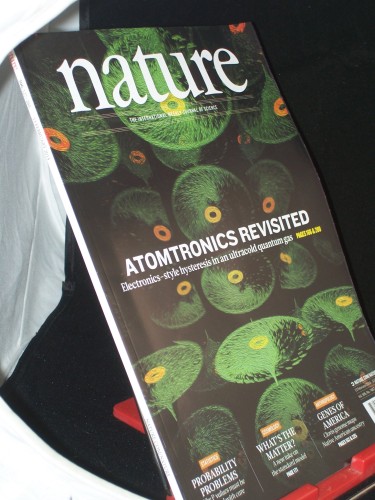
Quantum chaos in ultracold collisions of gas-phase erbium atoms
Albert Frisch,
Michael Mark,
Kiyotaka Aikawa,
Francesca Ferlaino,
John L. Bohn
+ et al.
An ultracold gas of erbium atoms is shown to have many scattering resonances whose quantum fluctuations exhibit chaotic behaviour resulting from the anisotropy of the atoms’ interactions.
See also
News & Views by Julienne
Reconciliation of the carbon budget in the ocean’s twilight zone
Sarah L. C. Giering,
Richard Sanders,
Richard S. Lampitt,
Thomas R. Anderson,
Christian Tamburini
+ et al.
The discrepancy between the components of the oceanic carbon budget — export of carbon from the surface and its conversion into carbon dioxide by water-column biota at depth — is reconciled using field data and a steady-state model which indicates that synergy between microbes and zooplankton is an important factor.
Geomagnetic fluctuations reveal stable stratification at the top of the Earth’s core
Bruce Buffett
MAC waves (arising from magnetic, Archimedes and Coriolis forces) in the liquid core indicate a 140-kilometre-thick stratified layer on top of the Earth’s core and account for the 60-year geomagnetic fluctuations observed in the Earth’s geomagnetic field.
Methane fluxes show consistent temperature dependence across microbial to ecosystem scales
Gabriel Yvon-Durocher,
Andrew P. Allen,
David Bastviken,
Ralf Conrad,
Cristian Gudasz
+ et al.
Meta-analyses show that the temperature dependence of methane fluxes scales consistently across populations of methanogens, microbial communities and whole ecosystems, and that this temperature dependence is higher than for respiration and photosynthesis; this indicates that global warming may impact the relative contributions of CO2 and CH4 to total greenhouse gas emissions.
See also
News & Views by Hoehler & Alperin
Geographical limits to species-range shifts are suggested by climate velocity
Michael T. Burrows,
David S. Schoeman,
Anthony J. Richardson,
Jorge García Molinos,
Ary Hoffmann
+ et al.
Global maps constructed using climate-change velocities to derive spatial trajectories for climatic niches between 1960 and 2100 show past and future shifts in ecological climate niches; properties of these trajectories are used to infer changes in species distributions, and thus identify areas that will act as climate sources and sinks, and geographical barriers to species migrations.
A suspension-feeding anomalocarid from the Early Cambrian
Jakob Vinther,
Martin Stein,
Nicholas R. Longrich &
David A. T. Harper
Tamisiocaris borealis, an Early Cambrian member of the anomalocarids—giant, predatory marine stem arthropods—probably used its frontal appendage to trap microscopic, planktonic animals.
A primitive placoderm sheds light on the origin of the jawed vertebrate face
Vincent Dupret,
Sophie Sanchez,
Daniel Goujet,
Paul Tafforeau &
Per E. Ahlberg
Studies of the head of the very primitive jawed vertebrate Romundina show that it combines jawed vertebrate architecture with cranial and cerebral proportions resembling those of extant jawless vertebrates such as lampreys.
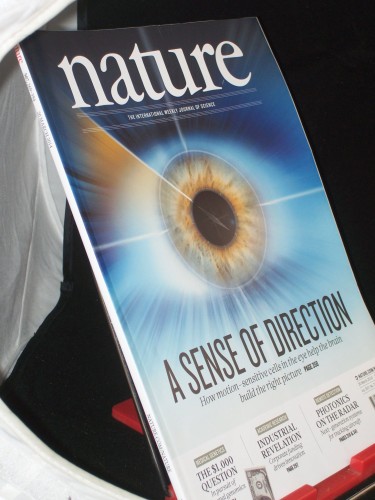
Visual space is compressed in prefrontal cortex before eye movements
Marc Zirnsak,
Nicholas A. Steinmetz,
Behrad Noudoost,
Kitty Z. Xu &
Tirin Moore
Saccadic eye movements cause substantial shifts in the retinal image as we take in visual scenes, but our perception is stable and continuous; here, visual receptive fields are shown to shift dramatically towards the saccadic goal, running counter to the long-standing hypothesis of receptive field remapping as the basis of perceived stability.
See also
News & Views by Assad
The E3 ligase Cbl-b and TAM receptors regulate cancer metastasis via natural killer cells
Magdalena Paolino,
Axel Choidas,
Stephanie Wallner,
Blanka Pranjic,
Iris Uribesalgo
+ et al.
The E3 ligase Cbl-b acts on TAM tyrosine kinase receptors and has a critical role in the regulation of natural killer (NK) cell rejection of metastatic tumours; a small molecule TAM kinase inhibitor is shown to enhance the anti-metastatic NK cell activity.
Transcription factor achaete-scute homologue 2 initiates follicular T-helper-cell development
Xindong Liu,
Xin Chen,
Bo Zhong,
Aibo Wang,
Xiaohu Wang
+ et al.
Here, the helix–loop–helix transcription factor Ascl2 is shown to be critically important for the initiation of follicular T-helper-cell development and the germinal centre response.
Structure-based programming of lymph-node targeting in molecular vaccines
Haipeng Liu,
Kelly D. Moynihan,
Yiran Zheng,
Gregory L. Szeto,
Adrienne V. Li
+ et al.
An amphiphile vaccine consisting of a peptide antigen or adjuvant cargo linked to a lipophilic tail is shown to have improved potency and safety in mice by targeting the lymph nodes.
gepflegtes Exemplar, nur kleine Lesespuren
- Verlag:
- NPG Nature publishing group
- Englische Ausgabe
- Artikelnummer:
- B00042575
- Gewicht:
- 400 gr
- Lagerplatz:
- Z7_4_18