History: A medieval multiverse
Ideas in a thirteenth-century treatise on the nature of matter still resonate today, say Tom C. B. McLeish and colleagues.
Policy: The art of science advice to government
Peter Gluckman, New Zealand's chief science adviser, offers his ten principles for building trust, influence, engagement and independence.
Books and Arts
Top
In retrospect: Sylva
Gabriel Hemery celebrates the 350th anniversary of John Evelyn's treatise on the science and practice of forestry.
Review of Sylva; Or a Discourse of Forest-Trees, and the Propagation of Timber in His Majesties Dominions
John Evelyn
Particle physics: Higgs on the big screen
Alexandra Witze savours a behind-the-scenes look at physics's most famous arrival.
Review of Particle Fever
Mark Levinson
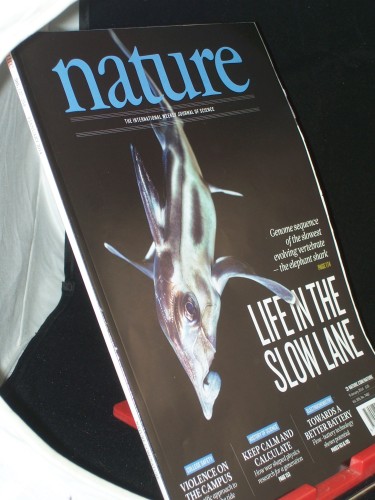
Evolutionary biology: Sex, lies and butterflies
David W. Loehlin &
Sean B. Carroll
See also
Letter by Kunte et al.
Astrophysics: Cosmic lens reveals spinning black hole
Guido Risaliti
See also
Letter by Reis et al.
Geology: Earth's deep water reservoir
Hans Keppler
See also
Letter by Pearson et al.
Neurodegenerative diseases: G-quadruplex poses quadruple threat
J. Paul Taylor
See also
Article by Haeusler et al.
Neuroscience: Ordered randomness in fly love songs
Bence P. Ölveczky
See also
Letter by Coen et al.
50 & 100 Years Ago
Evolutionary biology: Speciation undone
Peter R. Grant &
B. Rosemary Grant
Articles
Top
Alveolar progenitor and stem cells in lung development, renewal and cancer
Tushar J. Desai,
Douglas G. Brownfield &
Mark A. Krasnow
Lung alveoli are lined by two types of alveolar epithelial cells, squamous alveolar type (AT) 1 cells that mediate gas exchange and cuboidal AT2 cells that secrete surfactant to prevent alveolar collapse during breathing; here alveolar markers, genetic lineage tracing and clonal analysis are used in mice to identify alveolar progenitor and stem cells in vivo, and to map their locations and potential during lung development, maintenance and cancer.
C9orf72 nucleotide repeat structures initiate molecular cascades of disease
Aaron R. Haeusler,
Christopher J. Donnelly,
Goran Periz,
Eric A. J. Simko,
Patrick G. Shaw
+ et al.
Structurally polymorphic C9orf72 hexanucleotide repeats cause an impairment in transcriptional processivity and lead to accumulation of truncated repeat-containing transcripts that bind to specific ribonucleoproteins, such as nucleolin, in a conformation-dependent manner resulting in nucleolar stress and C9orf72-linked pathology in amyotrophic lateral sclerosis and frontotemporal dementia.
See also
News & Views by Taylor
Proof of principle for epitope-focused vaccine design
Bruno E. Correia,
John T. Bates,
Rebecca J. Loomis,
Gretchen Baneyx,
Chris Carrico
+ et al.
Computational protein design methods are used to generate new candidates for a human respiratory syncytial virus (RSV) vaccine; artificial protein scaffolds that mimic the structure of a RSV epitope are shown to induce RSV-specific neutralizing antibodies in macaques.
Letters
Top
Reflection from the strong gravity regime in a lensed quasar at redshift z = 0.658
R. C. Reis,
M. T. Reynolds,
J. M. Miller &
D. J. Walton
Observations of a gravitationally lensed quasar at redshift 0.658 imply a high spin parameter, which indicates that this supermassive black hole grew by coherent accretion rather than in a chaotic manner.
See also
News & Views by Risaliti
Interrogating selectivity in catalysis using molecular vibrations
Anat Milo,
Elizabeth N. Bess &
Matthew S. Sigman
A set of parameters based on the response of a molecule’s properties to infrared vibrations can be used to model and predict selectivity trends for molecular reactions with interlinked steric and electronic effects at positions of interest
Conformation-induced remote meta-C–H activation of amines
Ri-Yuan Tang,
Gang Li &
Jin-Quan Yu
In anilines and benzylic amines, a recyclable chemical template can direct the olefination and acetoxylation of meta-C–H bonds as far as 11 bonds away from a functional group; in particular, it is able to direct the meta-selective C–H functionalization of bicyclic heterocycles via a highly strained, tricyclic-cyclophane-like palladated intermediate.
Hydrous mantle transition zone indicated by ringwoodite included within diamond
D. G. Pearson,
F. E. Brenker,
F. Nestola,
J. McNeill,
L. Nasdala
+ et al.
X-ray diffraction, Raman and infrared spectroscopic evidence for the inclusion of water-rich ringwoodite in diamond from Juína, Brazil, indicates that, at least locally, the Earth’s transition zone is hydrous to about 1 weight per cent.
See also
News & Views by Keppler
Derived immune and ancestral pigmentation alleles in a 7,000-year-old Mesolithic European
Iñigo Olalde,
Morten E. Allentoft,
Federico Sánchez-Quinto,
Gabriel Santpere,
Charleston W. K. Chiang
+ et al.
A complete pre-agricultural European human genome from a ~7,000-year-old Mesolithic skeleton suggests the existence of a common genomic signature across western and central Eurasia from the Upper Paleolithic to the Mesolithic, and ancestral alleles in several skin pigmentation genes suggest that the light skin of modern Europeans was not yet ubiquitous in Mesolithic times.
doublesex is a mimicry supergene
K. Kunte,
W. Zhang,
A. Tenger-Trolander,
D. H. Palmer,
A. Martin
+ et al.
The phenomenon of sex-limited mimicry is phylogenetically widespread in the swallowtail butterfly genus Papilio — now, a single gene, doublesex, is shown to control supergene mimicry, a finding that is in contrast to the long-held view that supergenes are likely to be controlled by a tightly linked cluster of loci.
See also
News & Views by Loehlin & Carroll
Dynamic sensory cues shape song structure in Drosophila
Philip Coen,
Jan Clemens,
Andrew J. Weinstein,
Diego A. Pacheco,
Yi Deng
+ et al.
Drosophila male courtship songs were thought to have a fixed structure with song repetition variations introduced unintentionally because of neural noise; this behavioural assay and computational modelling study instead reveals that males use fast changes in sensory information to actively pattern individual song sequences.
See also
News & Views by Ölveczky
An excitatory paraventricular nucleus to AgRP neuron circuit that drives hunger
Michael J. Krashes,
Bhavik P. Shah,
Joseph C. Madara,
David P. Olson,
David E. Strochlic
+ et al.
The AgRP-expressing neurons in the arcuate nucleus drive food-seeking behaviours during caloric restriction; a mouse study of monosynaptic retrograde rabies spread and optogenetic circuit mapping reveals that these neurons are activated by input from hypothalamic paraventricular nucleus cells and their activation or inhibition can modulate feeding behaviour.
L-Myc expression by dendritic cells is required for optimal T-cell priming
Wumesh KC,
Ansuman T. Satpathy,
Aaron S. Rapaport,
Carlos G. Briseño,
Xiaodi Wu
+ et al.
L-Myc, a paralogue of the proto-oncogene c-Myc, is shown to regulate dendritic cell homeostasis and functionality; unlike c-Myc, L-Myc is not repressed by interferons and its expression allows for optimal dendritic cell proliferation and T-cell priming in the presence of inflammation.
A transcriptional switch underlies commitment to sexual development in malaria parasites
Björn F. C. Kafsack,
Núria Rovira-Graells,
Taane G. Clark,
Cristina Bancells,
Valerie M. Crowley
+ et al.
The DNA-binding protein PfAP2-G is found to be a master regulator of sexual development in the malaria parasite; this protein appears to regulate early gametocytogenesis and is epigenetically silenced in the majority of blood-stage parasites.
A cascade of DNA-binding proteins for sexual commitment and development in Plasmodium
Abhinav Sinha,
Katie R. Hughes,
Katarzyna K. Modrzynska,
Thomas D. Otto,
Claudia Pfander
+ et al.
Malaria parasites must produce gametocytes for transmission to the mosquito vector, although the molecular mechanisms underlying commitment to gametocyte production remain unclear; here this process is found to be controlled by PbAP2-G, a member of the ApiAP2 family of DNA-binding proteins, in the rodent-infecting Plasmodium berghei parasite.
DNA-guided DNA interference by a prokaryotic Argonaute
Daan C. Swarts,
Matthijs M. Jore,
Edze R. Westra,
Yifan Zhu,
Jorijn H. Janssen
+ et al.
Here, Argonaute from the prokaryote Thermus thermophilus is shown to use small DNA guides to interfere directly with invading foreign DNA, rather than being involved in RNA-guided RNA interference, as observed in eukaryotes.
gepflegtes Exemplar, nur kleine Lesespuren
- Verlag:
- NPG Nature publishing group
- Englische Ausgabe
- Artikelnummer:
- B00042586
- Gewicht:
- 400 gr
- Lagerplatz:
- Z7_4_18